
Ph.D. from The University of Tokyo: From
Theoretical Physics to AI Service Developer
Interview with CTO Takahiro Mikami
"AI is a behind-the-scenes tool. I want to be a
service provider that reaches end users."
CTO Takahiro Mikami
In his doctoral course, he obtained a Ph.D. in the field of condensed matter theory. He assumed the position of CTO of the company in February 2023.
Mikami, who has loved mathematics since his school days and wanted to pursue theoretical beauty, talks about what led him to become involved in AI development at NEURAL.
(*) Note: Evaluated as having achieved "extremely excellent results" with an average raw score of 90 or above over four years of undergraduate studies. Reference: Grading at The University of Tokyo
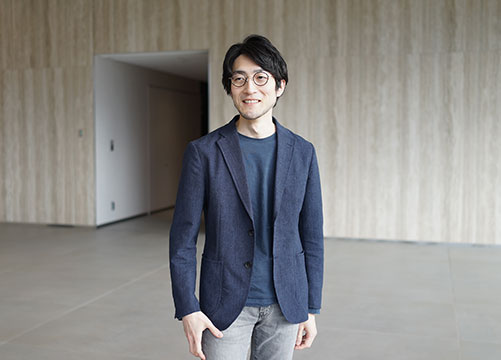
Mikami: In my doctoral program,
I obtained my Ph.D. in the field of condensed matter theory within theoretical physics.
This field uses the physical laws of quantum theory that govern the microscopic world at the atomic level
to unravel the properties of familiar materials. Since that time, I liked mathematics and had a strong desire to pursue theoretical
beauty,
but on the other hand, I also wanted to produce results that would be useful in the real world in some way.
I chose my doctoral research field through this kind of thinking,
and I believe I was able to cultivate a business perspective through my research.
I also acquired knowledge about system construction and algorithms,
such as creating large-scale simulations from scratch.
While writing my doctoral dissertation, I had a strong desire to contribute to things that are useful in the real world,
and ultimately, out of a desire to create things that directly benefit society,
I decided to leave academia. To learn about the real world,
I thought I would go out into society for a while,
and because I could leverage my practical experience in system development and research,
I joined Nomura Research Institute.
After joining Nomura Research Institute, Mikami worked there until 2020.
He says that the deep learning technology he encountered there had much in common with the mathematics of theoretical physics, allowing him to catch up quickly.
Mikami: I was with Nomura Research Institute for about five years. Belonging to a research and development department, I conducted technical research and front-loading to modernize system development,
and actually provided system implementation support to customers. Experiencing various projects,
I was able to grow both technically and as a businessperson, making it a very fruitful five years.
While I gained skills that allowed me to understand and practice system development well, my desire to use those skills not just to support clients, but,
to put it grandly, to create services myself that could leave a major impact on people's lives grew stronger. At the same time,
being in a large corporation, I sometimes felt it was difficult to take action.
While harboring such thoughts, I had the opportunity to encounter deep learning, a technology outside my field at the time, at an internal workshop.
Understanding the concepts behind image recognition models like ResNet and natural language models like LSTM, which were popular at the time, and implementing them was fun,
and before I knew it, I was so engrossed in it that I ended up winning the workshop competition.
I think the grounding in linear algebra and analysis from my theoretical physics research was highly compatible with the mathematical elements used in deep learning, such as tensor operations and backpropagation,
and it fit me well, allowing me to absorb it quickly.
At that time, I strongly realized that deep learning, which was still a new technology, could deliver an innovative and major impact to users.
Experiencing an assignment in San Francisco
and developing services in Silicon Valley
became a major turning point for Mikami.
Mikami: Using an internal program, I received the opportunity for an overseas assignment in the U.S.
It was a project to conduct a local needs survey, develop a new product from scratch,
and launch a startup company internally.
The public safety in San Francisco was not great, an environment where luggage theft occurred frequently,
and from a Japanese perspective, I keenly felt that it was not a reassuring environment.
At that time, I thought about how to make facilities like cafes safe environments to spend time in,
and came up with the idea that we could form a good community through a platform
where people watch over each other's luggage.
We actually interviewed local people in San Francisco,
created a prototype based on that, received feedback from users,
and went through the process of brushing it up to develop a new service,
which we then pitched to local investors.
I think this kind of experience was a good opportunity to think deeply about
what value is created not from a developer's perspective,
but from an end-user's perspective.
This experience is directly useful in my current development at NEURAL.
Later, while engaging in the research and development department,
I was approached by Sasaki, NEURAL's former CTO.
Sasaki is actually a classmate from physics at the University of Tokyo, and
our backgrounds as engineers overlap significantly.
At Neural Group, they actively use the latest AI technology to develop highly
value-added services, and I felt it was very attractive to be able to contribute
to the creation of new services myself rather than simply providing customer support.
I felt I could also utilize my own business sense, and decided to join NEURAL.
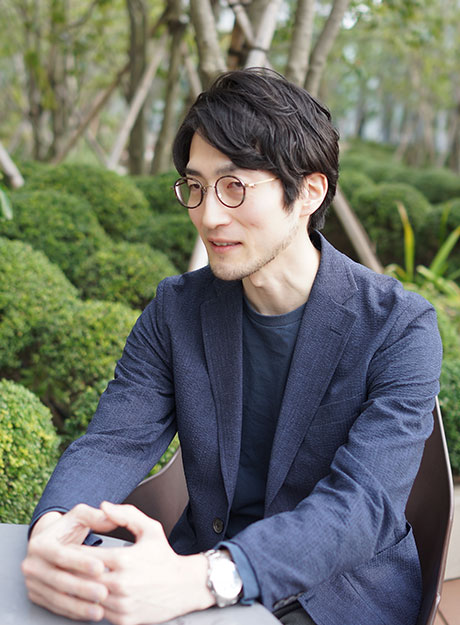
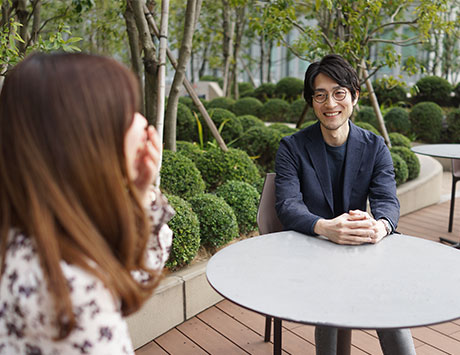
After that, Mikami joined the AI venture NEURAL.
Are there any tasks that left an impression on you at Neural Group?
Also, please tell us what you find useful
when developing services.
Mikami: The development of a solution called "Remodesk" left the deepest impression on me.
Coming right after I joined the company, it was a very meaningful project where I was able
to put "operating AI at the edge" into practice.
I felt a great sense of fulfillment in being able to develop with an overwhelming sense of speed
up to the service launch, while constantly thinking about optimization design for stable operation
even within the constraints of hardware performance.
The service Remodesk requires running an AI model on the user's web browser,
performing facial feature extraction and object detection of items like smartphones at a certain inference speed.
Users' PCs cannot be expected to have high specs,
and in order to satisfy such functional requirements on PC terminals with limited CPU capacity,
it was necessary to devise various approaches not only for model accuracy,
such as optimizing the model for web browsers, reducing the size of the model itself,
and separating Worker threads to improve the user's operational feel.
We also made design innovations such as switching to the optimal processing system
depending on the end user's hardware conditions.
I was very happy to be able to build a service using AI by tackling such
practical issues head-on, and ultimately provide a service that is used by customers.
It took about half a year from development to the initial release.
At NEURAL, we often take the approach of first building a prototype and using that as a starting point
to refine the service so that it can be used in a production environment.
Conducting feasibility verification in a short period of time,
and rapidly assembling high-quality products in commercial development by utilizing internal common libraries and know-how,
I think NEURAL's style and strength lies in quickly providing high-level services
in both business and technology.
Mikami has developed various AI services since joining NEURAL.
He says that good teamwork is also important for this kind of system development.
What are the strengths and appeal of Neural Group's technology development organization?
Mikami: NEURAL's engineers all have some kind of spike (outstanding skill),
and based on that core, they have built relationships where they can respect each other, which is considered a fundamental strength.
As a hiring standard, we do not evaluate solely on hard skills. We conduct high-hurdle hiring that emphasizes soft skills as well,
by conducting coding tests to test logical thinking abilities,
whiteboard tests to see if they can discuss problem-solving, and looking at communication skills during interviews.
The aim is to gather members who have the groundwork to positively tackle their own growth as engineers while
cooperating with others after joining the company. Team development is the basis at NEURAL, so we try to ascertain
whether they are personnel who can shine in that environment, placing importance on thinking ability,
conceptual ability, understanding of others, and ability to communicate to others.
We never judge simply based on their current skills alone.
We are looking for individuals where each person has their own strengths, relationships of mutual respect can be
formed, and when a team is formed, the team's output can be maximized.
I feel that such aims have borne fruit, and we have gathered members with high basic abilities who fit our culture.
Our thinking around this area is publicly available in a video from when I previously spoke at an AWS webinar.
Video: Mindset and Skillset Supporting Neural's Growth
I constantly feel that NEURAL's current engineers are an elite few but a wonderful group of members
with outstanding teamwork, and I feel happy that I myself can enjoy developing as an engineer.
An organization where you can focus on creating good products enjoyably with reliable members
is what I think is NEURAL's greatest appeal.